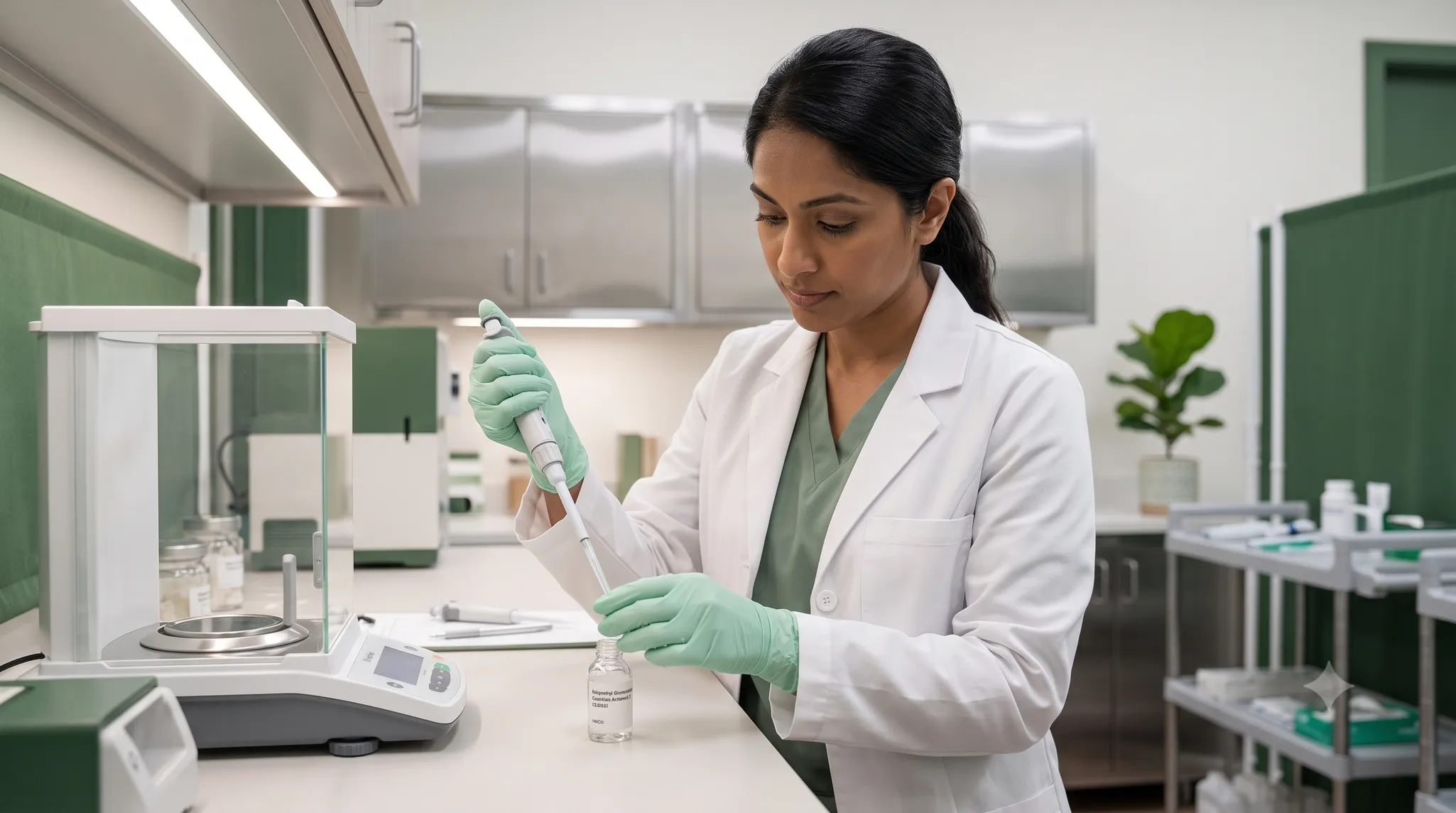
Compounded medication is a preparation made for an individual patient by a licensed pharmacist or physician, rather than a mass-manufactured drug product. The FDA describes compounding as creating a medication tailored to the needs of an individual patient. At MacArthur Gastroenterology, your GLP-1 medication is compounded specifically for your treatment plan and administered in-clinic.
What Does “Compounded” Actually Mean?
Compounding means a pharmacist or physician prepares a medication using individual components, rather than dispensing a pre-manufactured product straight from a factory line. This practice has existed for decades and serves a real clinical purpose: it allows a preparation to be tailored when a standard manufactured product doesn’t fit a particular patient’s needs.
Why Would a Physician Use a Compounded Medication?
Compounded preparations let a physician adjust formulation details to an individual treatment plan in ways a fixed manufactured product doesn’t allow. This is a legitimate and long-established part of medical practice, not a workaround.
Is Compounded Medication FDA-Approved?
No, not in the way a manufactured drug product is. Compounded medications are not FDA-approved individually the way a new drug goes through the FDA’s formal approval process. Compounding pharmacies operate under a different regulatory framework, described in FDA guidance, that focuses on ingredient quality, facility standards, and pharmacist oversight rather than product-by-product approval.
This distinction matters, and your physician will walk you through exactly what it means for your specific treatment.
How Is a Compounding Pharmacy Regulated?
Compounding falls under two main regulatory categories:
- Section 503A pharmacies compound on a patient-specific basis under a valid prescription, overseen primarily by state boards of pharmacy alongside FDA requirements on ingredient sourcing.
- Section 503B outsourcing facilities compound at larger scale and are held to current good manufacturing practice standards with more direct FDA oversight.
Regardless of which framework applies, federal law requires safe, sanitary compounding conditions, and compounded products must be sourced from FDA-registered ingredient suppliers.
What Does This Mean for Your Program?
Practically, it means a few specific things for your treatment:
- Your medication is prepared for your individual plan, not pulled from a mass-produced, brand-name product.
- It is administered in-clinic by subcutaneous injection and is never shipped to your home.
- It is not FDA-approved the same way a manufactured drug product is; your physician will explain what that means for you.
- Results vary from person to person, and no specific outcome is promised or guaranteed.
If you have questions about sourcing, ingredients, or oversight for your specific medication, ask your care team directly. See how GLP-1 medications work as part of your program.
For more on how compounded medication fits into your overall care, visit our weight management program page.
Frequently Asked Questions
Is compounded medication the same as a generic drug?
No. A generic drug is a separately FDA-approved product. Compounded medication is prepared individually and isn’t approved through that same process.
Is compounded medication safe?
Compounding is a long-established, regulated practice, but it operates under different oversight than manufactured drug approval. Your physician can explain the specific safeguards in place for your treatment.
Why not just prescribe a manufactured product instead?
That decision depends on your individual treatment plan and clinical circumstances. Your physician can explain the reasoning behind your specific prescription.
Is this article medical or legal advice?
No. This content is educational and general in nature. Talk with your physician about your specific medication and treatment plan.
References
- FDA, Compounding and the FDA: Questions and Answers
- FDA, FD&C Act Provisions That Apply to Human Drug Compounding

Dr. Ralph Peterson brings more than 40 years of medical experience to MacArthur Gastroenterology, including over 30 years specializing in gastroenterology and internal medicine. For more than 12 years, his practice has focused on treating viral hepatitis, achieving a cure rate above 90% in Hepatitis B and C cases. He is a sought-after speaker and medical presenter on colorectal cancer and on the treatment and cure of Hepatitis B and C.
Dr. Peterson has served on the advisory boards of leading pharmaceutical companies, including Gilead, and is also Medical Director of uFirst Health Partners, a nonprofit organization dedicated to fatty liver disease awareness and education. He also leads research and development at NEXT2ME, LLC, where he invented the 1440 Vibrational Energetic Spray supplement line.
His work has taken him well beyond the clinic, including service as a medical team leader in Sierra Leone, evaluating medical needs across multiple provinces, and as a volunteer physician in Bohol, Philippines, training local providers in the treatment of gastrointestinal disease and hepatitis.
A former Master's Track & Field world record holder in the 4x100 relay, Dr. Peterson has been recognized by the American Cancer Society, 100 Black Men of America, 100 Black Men of the Bay Area, and the Alameda County Board of Supervisors for his outstanding service to men's health.
- Ralph L. Peterson, MD

- Ralph L. Peterson, MD

- Ralph L. Peterson, MD

- Ralph L. Peterson, MD