Velacur ONE is the liver scan used at MacArthur Gastroenterology to check for fat, stiffness, and early signs of liver damage. It’s a point-of-care ultrasound device, cleared by the FDA in 2025, that uses gentle shear waves to measure your liver in about 15 to 20 minutes, without needles or sedation. Results are ready the same visit.
How Does Velacur ONE Actually Scan the Liver?
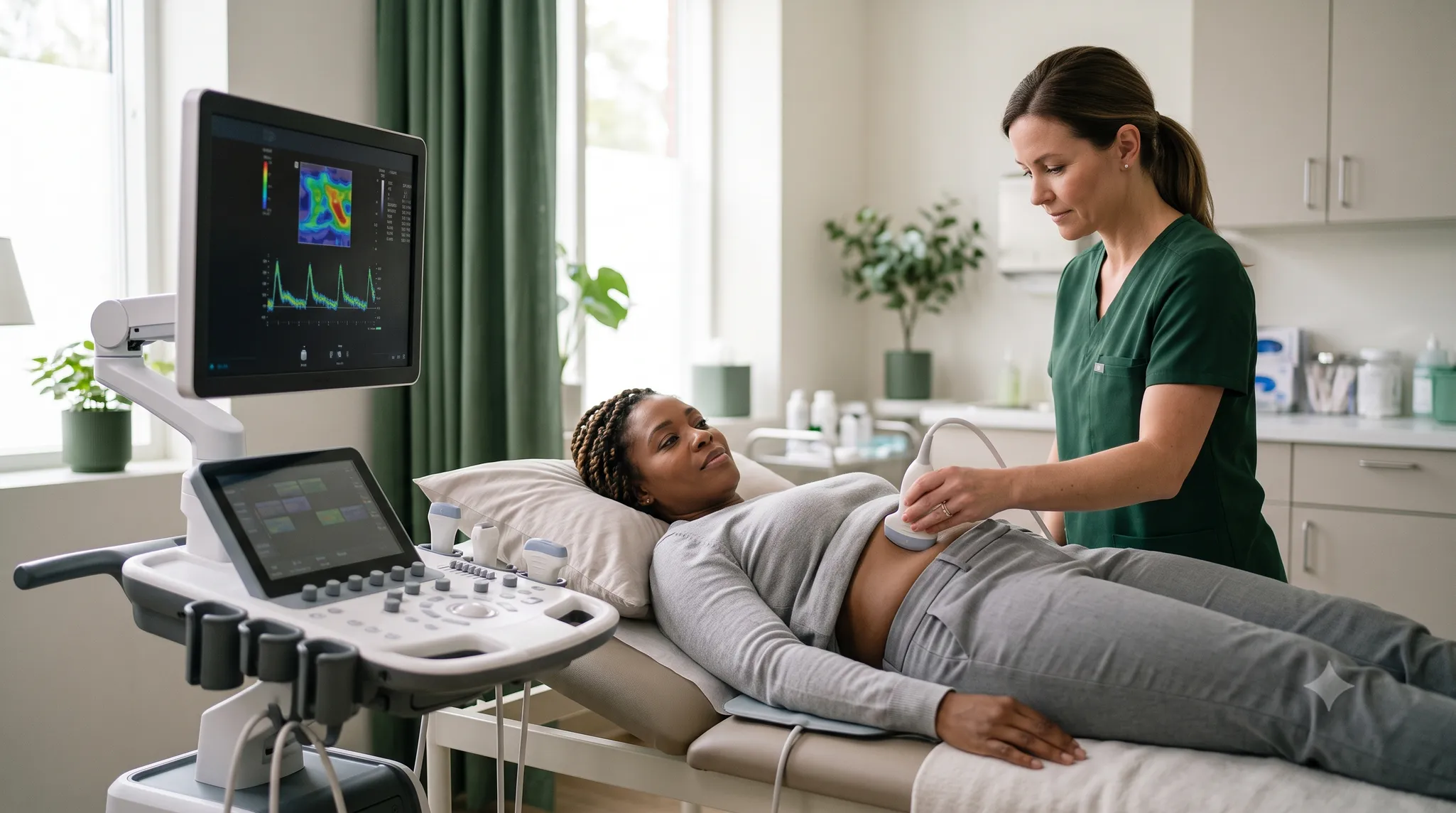
The scan uses a simple three-step process. First, a padded activator placed under your back generates gentle, steady shear waves that pass through your liver. Second, a handheld probe sweeps across your side to collect a 3D volume of measurements as those waves travel through the tissue. Third, your results appear in real time, ready to review with your care team before you leave.
Built-in AI guidance helps the person performing the scan locate your liver accurately and confirms that the wave signal is strong enough for a reliable reading, even in technically difficult cases. According to Sonic Incytes, the manufacturer, this approach can sample a substantially larger volume of liver tissue than older transient elastography methods.
What Does It Measure?
Velacur ONE reports three main measurements:
- Liver stiffness, an indicator of scarring or fibrosis
- Attenuation, a measure of how much fat is present in the liver
- VDFF (Velacur Determined-Fat Fraction), a proprietary fat-quantification score
The company reports that VDFF correlates strongly with MRI-PDFF, the imaging-based gold standard for measuring liver fat, and that it performs well at identifying clinically significant fat buildup. Independent confirmation of these figures in your own results is something your physician can discuss directly with you.
How Is It Different from Older Liver Elastography?
Earlier point-of-care elastography devices typically used a single-frequency vibration source and sampled a narrower column of tissue. Velacur ONE instead generates steady, multi-frequency shear waves and combines that with B-mode ultrasound imaging, which helps confirm the probe is positioned correctly over liver tissue rather than surrounding structures.
The FDA clearance for Velacur ONE was granted in August 2025, per reporting from AuntMinnie, a widely read radiology industry publication. FDA 510(k) clearance means the device has met the agency’s requirements to be marketed as substantially equivalent to existing devices. It is a clearance, not a drug-style approval, and it applies to the device rather than to any medication.
Is the Scan Safe and Comfortable?
Yes. The scan is noninvasive, requires no needles, no sedation, and no radiation. Most patients describe it as similar to a routine ultrasound. You lie back comfortably while the activator pad and probe do the work, and the entire visit typically takes well under half an hour.
What Happens After Your Scan?
Your physician reviews your stiffness, attenuation, and VDFF results with you the same day. These numbers help determine whether you’re in an early stage of fat buildup, whether there’s evidence of inflammation or scarring, and what a reasonable next step looks like, whether that’s lifestyle changes, closer monitoring, or referral for additional testing.
Many insurance plans may cover the exam when it’s medically appropriate. Coverage details vary by plan.
Frequently Asked Questions
Does the Velacur ONE scan hurt?
No. It’s noninvasive, requires no needles, and most patients find it comfortable, similar to a standard ultrasound.
Is Velacur ONE the same as an MRI?
No. It’s a point-of-care ultrasound-based scan. The manufacturer reports its fat measurement correlates well with MRI-based imaging, but it is a different technology performed in-office rather than in a radiology suite.
How long does the scan take?
The scan itself typically takes about 15 to 20 minutes, with results available the same visit.
Is this article a substitute for medical advice?
No. This content is educational and general in nature, not medical advice. Talk with your physician about whether liver screening is right for you.